
Badrinath gets the crowds. Everything around it gets ignored.
Here’s what happens on most Badrinath trips. The bus or car arrives after a long drive up the Alaknanda valley. The temple queue forms. Darshan happens. Photographs get taken. People leave.
The Garhwal Himalayas around Badrinath, some of the most extraordinary terrain in Asia, get approximately forty-five minutes of attention between the parking lot and the prasad counter.
That’s not a criticism. The temple is the reason most people come and it absolutely deserves the journey. But the places to visit near Badrinath extend well beyond the main shrine, and the traveller who builds a day or two around the surrounding landscape comes back with a fundamentally different trip than the one who turns around after darshan.
A valley that blooms for exactly three months. A thermal spring at 10,000 feet. The last village before Tibet. A glacial lake shaped like a triangle with peaks for walls. These exist within reach of Badrinath and most visitors never find them.
Best Places Near Badrinath for Nature & Spiritual Travel
There are several incredible places to visit near Badrinath that go far beyond the temple. From spiritual landmarks rooted in mythology to high-altitude treks that test endurance, this region offers a rare combination of experiences. For travelers building a complete Badrinath travel guide, these locations are not optional — they define the journey.
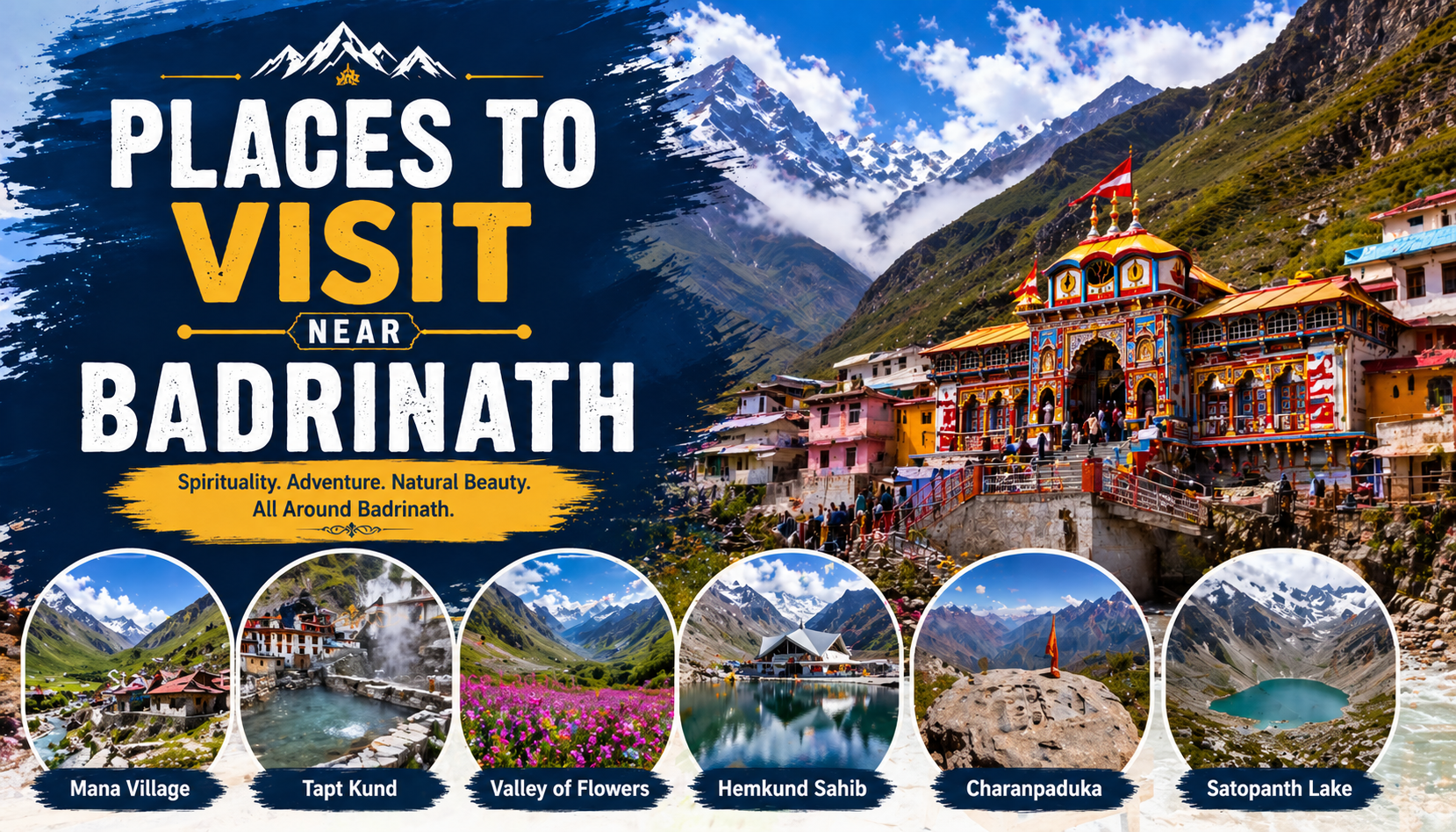
Mana Village: Three Kilometres and Completely Different
The last Indian village before the Tibetan border sits three kilometres from the temple. Most people have heard of it. Fewer actually go.
Mana Village Badrinath is one of the most culturally rich tourist places near Badrinath, yet it remains surprisingly underexplored. Mana is small, stone houses, narrow lanes, residents who have wintered at this altitude for generations.
The surrounding area carries more mythology per square kilometre than almost anywhere else in the country. The Saraswati River surfaces from rock here, runs briefly visible, then vanishes underground again. Bhim Pul, a single massive rock spanning the river, according to tradition was placed there by Bhima himself during the Pandavas’ final journey. Vyas Gufa, a cave nearby, is where the Mahabharata was supposedly composed and dictated.
None of this is theme park mythology with signs explaining the significance. The cave is a cave. The rock bridge is a rock bridge. The river appears from stone and disappears back into it. The landscape does the work without interpretation boards.
Budget two hours minimum. Go early before the day-trip crowds from Badrinath arrive.
Tapt Kund: Right Next to the Temple, Consistently Rushed Past
Hot spring. Natural. 45 degrees Celsius. At 10,000 feet in the Himalayas, surrounded by glacial peaks.
Tapt Kund Badrinath sits adjacent to the temple and is one of the most unique things to do near Badrinath. Pilgrims have been bathing here before entering the shrine for centuries. Ancient texts describe it as Agni’s fire maintained underground at this elevation.
The geological reality, thermal water emerging naturally from rock at this altitude in this cold, is remarkable entirely apart from the religious framing.
Most visitors use it quickly and move on. The ones who stop and actually register where they’re standing tend to say it’s the moment the place truly connected for them.
Valley of Flowers: Needs Timing, Worth Planning Around
87 kilometres from Badrinath. UNESCO listed. A high-altitude valley that exists in a perpetual state of irrelevance for nine months a year and then, between July and September, covers itself in alpine flowers.
The Valley of Flowers trek is one of the most scenic places to visit near Badrinath for nature lovers. Primulas, poppies, orchids, Himalayan species that grow nowhere else at this elevation. The surrounding peaks frame the valley floor without obstruction. The photographs look edited. They aren’t.
The trek from Govindghat takes two days for most people. Not technically demanding, but the altitude is the only real challenge.
Anyone planning things to do near Badrinath during monsoon months should treat this as essential rather than optional.
Hemkund Sahib: The Climb Is the Point
4,329 metres. One of the highest Gurudwaras on earth. A glacial lake beside it reflecting the peaks.
The Hemkund Sahib trek is physically demanding and one of the most spiritually rewarding places to visit near Badrinath. The climb takes five to six hours, and every step builds toward a moment that feels earned.
The Gurudwara, the lake, the silence at that altitude — all arrive together.
The accessible window matches Valley of Flowers, making it easy to combine both into a single itinerary.
Charanpaduka: Twenty Minutes, Most People Skip It
A flat rock near the temple bearing impressions traditionally identified as Vishnu’s footprints. The walk from Badrinath takes twenty minutes.
Charanpaduka Badrinath is among the most underrated tourist places near Badrinath, and the real reason to visit is the view. The Alaknanda valley opens fully here, with Neelkanth peak directly in sight.
Twenty minutes up, twenty minutes back. Most people skip it. Most people are wrong to.
Satopanth Lake: Only for the Prepared
24 kilometres from Badrinath. 4,402 metres elevation. A glacial lake shaped like a triangle.
The Satopanth Lake trek is for serious trekkers and easily one of the most rewarding places to visit near Badrinath. The surrounding peaks rise sharply, creating an environment that feels untouched.
This is not casual travel. It requires preparation, fitness, and proper guidance.
For those who make it, Satopanth becomes the highlight of their entire Badrinath journey.
Where to Stay Near Badrinath for a Comfortable Trip
While exploring these places to visit near Badrinath, choosing the right stay becomes important.
There are several hotels near Badrinath ranging from budget lodges to mid-range accommodations. Most travelers prefer staying close to the temple for convenience, making stay near Badrinath Temple a practical choice.
You can also find decent accommodation in Badrinath and nearby areas like Joshimath. Planning your places to stay near Badrinath in advance ensures better comfort, especially during peak yatra season.
Hotels Near Me in Badrinath – What Travelers Should Know
Many travelers rely on quick searches like hotels near me in Badrinath during their journey. While this works in peak areas, availability can be limited during the yatra season.
Pre-booking is always a better option to secure the best possible stay.
A Few Things Worth Knowing
The Badrinath region is open from May through November. Valley of Flowers and Hemkund Sahib are open only from July through September.
Altitude is the variable that affects most travelers. Badrinath itself sits above 10,000 feet. A rest day before exploring nearby places to visit near Badrinath is essential.
Local guides are highly recommended, especially for treks. They provide context that enhances the experience beyond navigation.
Planning Your Badrinath Trip Beyond the Temple
Most people visit Badrinath for the temple, but the real experience lies in exploring the surrounding region. The places to visit near Badrinath offer a mix of spirituality, nature, and adventure that goes far beyond a single stop.
From Mana Village to high-altitude treks like Satopanth, each destination adds depth to the journey. Slowing down and extending your stay allows you to experience Badrinath not just as a pilgrimage, but as a complete Himalayan destination.
FAQs
Q1. What are the best places to visit near Badrinath?
Some of the best places include Mana Village, Valley of Flowers, Hemkund Sahib, Charanpaduka, and Satopanth Lake.
Q2. How many days are enough to explore places near Badrinath?
A 3–5 day trip is ideal to cover major attractions and nearby treks comfortably.
Q3. Are there good hotels near Badrinath?
Yes, there are multiple hotels near Badrinath offering budget and mid-range stays for travelers.
Q4. What is the best time to visit places near Badrinath?
May to October is the best time, while treks like Valley of Flowers are ideal between July and September.
Q5. Is Mana Village worth visiting?
Yes, Mana Village Badrinath is one of the most unique cultural destinations near the temple.
Q6. Are treks near Badrinath difficult?
Some treks like Valley of Flowers are moderate, while Satopanth Lake trek requires advanced preparation.
Q7. Can I find accommodation near Badrinath easily?
Yes, but booking in advance is recommended during peak season.
Q8. Is Badrinath safe for solo travelers?
Yes, Badrinath is generally safe, but proper planning is important.
Q9. What should I pack for visiting Badrinath?
Warm clothes, good shoes, medicines, and essentials are recommended.
Q10. Can I explore nearby places in one day?
Some places like Mana Village and Charanpaduka can be covered in a day, but others require more time.